Category Archives: Environment

Posts and comments related to environmental factors.

Nature is simply spectacular!

STORM CHASERS CATCH RARE TORNADO VIDEO

Angie Asimus, Seven News, Yahoo!7   Updated November 24, 2012, 5:19 pm

Rare tornado caught in dramatic video

A Brisbane storm chaser has captured dramatic video of the moment a tornado touched down in the Darling Downs.

A storm chaser has captured rare and dramatic video of a tornado tearing through farmland in western Queensland.

Anthony Cornelius from Down Under Chasing says the system came close to pounding the town of Dalby with cyclonic winds.

While it only lasted a few minutes, the system came close to hitting a populated area and triggered hail and winds of up to 110km/h.

More than 20 inland tornadoes are recorded in Australia each year, usually in remote areas.

“We certainly saw the dust start to spin up underneath the base of the storm, which certainly grabbed our attention,” said storm chaser Anthony Cornelius.

“We certainly did expect the potential to be some nice storms, not quite a very large supercell with a small tornado.”

The superstorm turned day into night as it made contact with land.

Residents were lucky to have only seen the tornado from a distance, with particular dangers involved in being near the natural phenomenon.

“You’ve actually got strong updrafts developing through the cloud and the air that comes into them is often uneven. That induces a rotation in the cloud,” said weather expert Dick Whitaker.

“It’s certainly well and truly strong enough to do structural damage to houses and power lines and trees.”

A menacing storm spiralling over the Darling Downs.

Budgies have lives outside cages!

Budgerigars are unique to Australia, and live in the ‘Outback’, – very remote areas of Australia!
—————————————————————————–

A flight to behold

Date   November 21, 2012 – 10:52PM

Thousands of wild budgerigars take to the skies above central Australia in a spectacular display.

Budgerigar numbers increase in  Central Australia with Murmurations such as these gathering around waterholes.Click for more photos

Thousands of budgies form large murmurations

Budgerigar numbers increase in Central Australia with Murmurations such as these gathering around waterholes. Photo: Glenn Campbell

  • Budgerigar numbers increase in  Central Australia with Murmurations such as these gathering around waterholes.
  • Budgerigar numbers increase in  Central Australia with Murmurations such as these gathering around waterholes.
  • Budgerigar numbers increase in  Central Australia with Murmurations such as these gathering around waterholes.
  • Budgerigar numbers increase in  Central Australia with Murmurations such as these gathering around waterholes.
  • Budgerigar numbers increase in  Central Australia with Murmurations such as these gathering around waterholes.
  • Budgerigar numbers increase in  Central Australia with Murmurations such as these gathering around waterholes.
  • Budgerigar numbers increase in  Central Australia with Murmurations such as these gathering around waterholes.
  • Budgerigar numbers increase in  Central Australia with Murmurations such as these gathering around waterholes
  • Budgerigar numbers increase in  Central Australia with Murmurations such as these gathering around waterholes. A brown Falcon hunts for strays in the flock.
  • Budgerigar numbers increase in  Central Australia with Murmurations such as these gathering around waterholes.

AFTER two wet years, central Australia is starting to dry out and birdlife that bred enthusiastically during abundant seasons are competing for a drink.

About 30 kilometres south of Alice Springs, tens of thousands of budgerigars descend on a waterhole, turning the blue horizon into a blur of green and yellow.

”Typically what proceeds this type of event is you have a couple of very good seasons and the birds breed continuously,” says Lisa Nunn, specialist keeper of birds at Alice Springs Desert Park.

”We had that here in 2010 and in the beginning of 2011. Then it dries out and they end up really concentrated around the last remaining water sources.

”It is beautiful… and the birds of prey that hang around the waterhole have a field day.”

Read more: http://www.theage.com.au/environment/a-flight-to-behold-20121121-29qgv.html#ixzz2CrepLUvK

Remember when, not so long ago, the experts, the scientists, proclaimed that, without doubt, there is no other life in the universe, and there never was!

Well, it’s amazing what can happen a few years down the track! The experts of old, now really do look like idiots. Actually, that is my definition of an ‘expert’ anyway,…, 🙂
——————————————————————

Has Curiosity Made an ‘Earth-Shaking’ Discovery?

by NANCY ATKINSON on NOVEMBER 20, 2012

Want to stay on top of all the space news? Follow @universetoday on Twitter

This image was taken by Front Hazcam onboard NASA’s Mars rover Curiosity on Sol 102 (2012-11-18 21:41:54 UTC). Credit: NASA/JPL-Caltech

The Mars Science Laboratory team has hinted that they might have some big news to share soon. But like good scientists, they are waiting until they verify their results before saying anything definitive. In an interview on NPR today, MSL Principal Investigator John Grotzinger said a recent soil sample test in the SAM instrument (Sample Analysis at Mars) shows something ‘earthshaking.’

“This data is gonna be one for the history books,” he said. “It’s looking really good.”

What could it be?

SAM is designed to investigate the chemical and isotopic composition of the Martian atmosphere and soil. In particular, SAM is looking for organic molecules, which is important in the search for life on Mars. Life as we know it cannot exist without organic molecules; however, they can exist without life. SAM will be able to detect lower concentrations of a wider variety of organic molecules than any other instrument yet sent to Mars.

As many scientists have said, both the presence and the absence of organic molecules would be important science results, as both would provide important information about the environmental conditions of Gale Crater on Mars.

But something ‘Earthshaking’ or “really good” probably wouldn’t be a nil result.

Already, the team has found evidence for huge amounts of flowing water in Gale Crater.

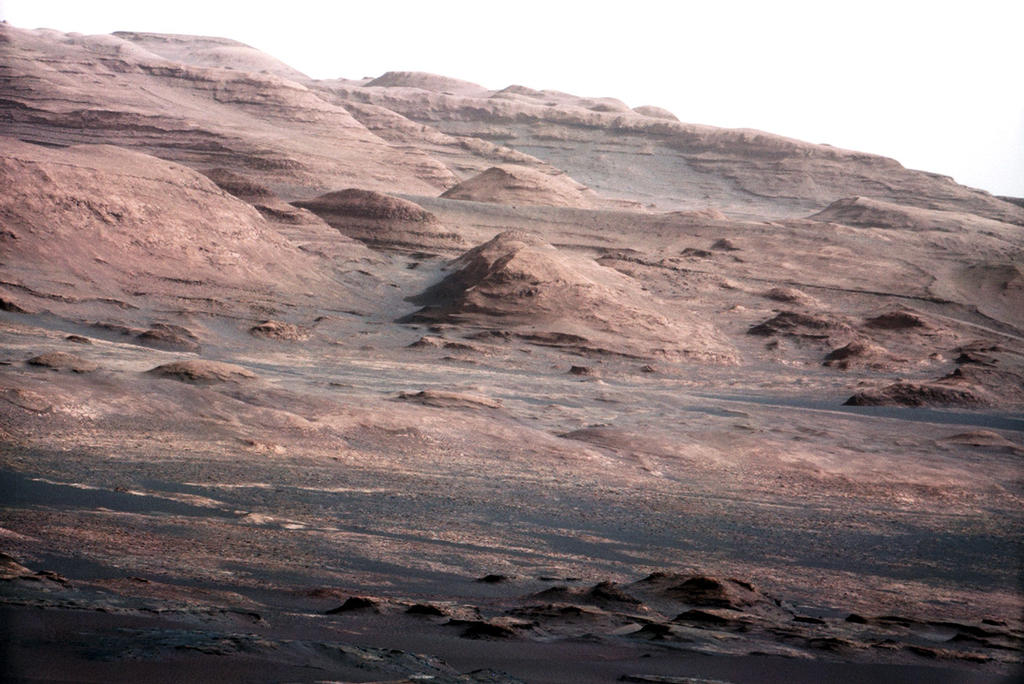
A detailed look at the layers on Aeolis Mons/Mt. Sharp, the central mound inside Gale Crater, the Curiosity rover’s ultimate destination. Credit: NASA/Caltech-JPL/MSSS

If SAM does find organic material, the next step would be to determine the origin and the nature of preservation of the molecules. But the team is going to wait until they verify whatever it is they found.

As NPR’s Joe Palca says in his report, “They have some exciting new results from one of the rover’s instruments. On the one hand, they’d like to tell everybody what they found, but on the other, they have to wait because they want to make sure their results are not just some fluke or error in their instrument.”

The team is being cautious because of their experience with looking for methane in the Martian air. When one of the SAM instruments analyzed an air sample, they got a reading of methane. But, it turned out, they were likely measuring some of the air that was brought along from Florida, as air leaked into the Tunable Laser Spectrometer (TLS) while the spacecraft was awaiting launch. The initial readings from the TLS, full of methane, were very exciting to the Curiosity scientists until they realized it was from Earth.

But NPR reports that Grotzinger says it will take several weeks before he and his team are ready to talk about their latest finding.

In the meantime there will likely be much speculation as everyone is excited about the prospects of life – past or present – on Mars. Either would have astounding implications.

Read more: http://www.universetoday.com/98576/has-curiosity-made-an-earth-shaking-discovery/#ixzz2CpTjbFD5

Good news for a change!!! :)

Falcons – not your average CBD residents

Date   November 20, 2012 – 5:07PM

Stephen Cauchi and Antoni Partington

Falcons – not your average CBD residents

The built-up environs of Melbourne’s CBD are hardly ideal for wildlife, but for a family of falcons it’s home sweet home.

The built-up environs of Melbourne’s CBD are hardly ideal for wildlife, but for one pair of peregrine falcons – the world’s fastest animal – it is home sweet home.

Unlike most birds, peregrine falcons don’t build stick nests. Instead they carve out scrape nests, usually on a high cliff or on the window ledges of tall buildings.

On the 33rd floor of 367 Collins Street, there have been five pairs of falcons since 1991. The most recent pair became proud parents four weeks ago when three nestlings hatched.

As their parents swooped outside, nestlings are brought inside to be tagged with a coloured metal band on each leg.As their parents swoop outside, nestlings are brought inside to be tagged with a coloured metal band on each leg. Photo: Antoni Partington

Yesterday, Victorian Peregrine Project Manager Victor Hurley “banded” the nestlings. As their parents swooped outside, the nestlings were brought inside the building to be tagged with a coloured metal band on each leg.

“We can read these (the bands) on a telescope from 250 metres away,” said Mr Hurley.

“We can monitor where they go, how long they live for, how many young they’re having, what sort of nest sites they’re using, that sort of thing,” said Mr Hurley.

Unfortunately, it will also be used to identify many of them when they die.

“Here, 80 per cent of the young die within the first six months of leaving the nest,” he said. “They hit windows, hit cars, hit wires, drown in rooftop swimming pools, get inside a building and starve to death on the weekend,” he said. “And they’re trapped, shot and poisoned illegally by people who race pigeons. You name it, things are happening to them.”

Consequently, said Mr Hurley, in Victoria there’s only about 40 to 50 band-wearing adults.

Collins Street is one of 180 sites in Victoria and is one of the more productive sites, with 36 nestlings over 22 years. There’s even a closed-circuit TV relaying footage of the nest to a screen in the 367 Collins foyer.

Besides being fast – they can reach 300 km/h in a swoop – peregrine falcons are predators, feeding on other birds. Melbourne’s green spaces, said Mr Hurley, are rich with quail, sparrows, starlings, pigeons, and other tasty treats. Albert Park Lake and the Altona grasslands are particularly popular feeding spots.

Consequently, the Collins Street nest looks set to remain inhabited. “The regular return of these birds to the CBD is a good sign of Melbourne’s liveability for our birdlife,” he said.

Read more: http://www.theage.com.au/victoria/falcons–not-your-average-cbd-residents-20121120-29nuq.html#ixzz2ClE7yLmV

Global Warming IS Real!

And the only person who did not believe in Global Warming was,…, YES! Tony Blabbott!!! The leader of the opposition in Australia!
————————————————–

Degrees of devastation: major report warns of drastically hotter planet

Date    November 19, 2012 – 12:33PM

Tom Arup

World Bank warns of climate change ‘disaster’

Unless action is taken now, World Bank president Jim Yong Kim warns, the planet faces disastrous consequences. (Supplied vision)

The World Bank has warned the planet is on track to warm by four degrees Celsius this century – causing increasingly extreme heat waves, lower crop yields and rising sea levels – unless significant action is taken to cut greenhouse gas emissions.

In a major report released ahead of the year-end United Nations climate summit in Qatar, the bank says changes associated with four degrees of warming would have dramatic and devastating effects on all parts of the world, including Australia, but that the poor would be most vulnerable.

Scientists say global warming must be kept within two degrees of pre-industrial temperatures to give the world the best chance of avoiding the worst impacts of climate change.

'I still find that much of what is attributed to climate change is just plain wrong.'Climate change is coming to a planet near you.

The report – a snapshot of the most recent climate science prepared for the bank by the Potsdam Institute for Climate Impact Research and Climate Analytics – says global mean warming is now about 0.8 degrees above pre-industrial levels.

It says that if current promises by nations to curb emissions are met then it is most likely there will be more than three degrees warming. However, under that scenario it warns there is also a 20 per cent likelihood that four degrees of warming will occur by 2100.

If current promises are not met, then the world is “plausibly” on a path to warm by four degrees this century, possibly as early as 2060, the bank says.

The report, titled Turn Down the Heat, says if the world experiences four degrees of warming it would:

* See a 150 per cent increase in ocean acidity, leading to the extinction of some sensitive coral reef ecosystems.

* Result in sea-level rise of 0.5 to 1 metres by 2100, with more in following centuries, affecting low-lying islands and coastal communities.

* Lead to more extreme heatwaves, reduced run-off into major rivers and a significant decline in biodiversity, all risking the support systems of humans.

The report says the full impact on human development of a four-degree-hotter world is unknown, making it is unclear whether humanity would be able to adapt.

“A 4°C world is likely to be one in which communities, cities and countries would experience severe disruptions, damage, and dislocation, with many of these risks spread unequally,” the report says.

“It is likely that the poor will suffer most and the global community could become more fractured, and unequal than today.”

World Bank Group president Jim Yong Kim said: “A four-degree-warmer world can, and must be avoided – we need to hold warming below two degrees.”

“Lack of action on climate change threatens to make the world our children inherit a completely different world than we are living in today. Climate change is one of the single biggest challenges facing development, and we need to assume the moral responsibility to take action on behalf of future generations, especially the poorest.”

United Nations Secretary-General Ban Ki-moon said: “This new report from the World Bank reminds us that climate change is happening – now. The evidence is clear. No country is immune. If we mobilise today, we can make a difference tomorrow.”

The World Bank is the second major international body this month to raise concerns about the rate of greenhouse gas emissions being released into the atmosphere.

The International Energy Agency last week warned in its latest World Energy Outlook that no more than a third of the world’s proven fossil fuel reserves can be consumed to 2050, without carbon capture and storage technology, if the two degrees target is to be met.

The warnings come as nations meet in Doha, Qatar next week for the next major round of international climate change negotiations.

Read more: http://www.theage.com.au/environment/degrees-of-devastation-major-report-warns-of-drastically-hotter-planet-20121119-29l3c.html#ixzz2Ce0maaTk

Well, well, surprise! Surprise! NOT!!!

When will mankind learn that nothing exists in isolation! When will mankind learn, that there is no such thing as ‘we will only change this bit; it won’t affect anything else’. When will mankind learn from history? When will mankind learn that nature got it right, long before mankind took its first steps! When will mankind learn that in its quest for the dollar that it is destroying itself!
——————————————–

Pesticide Use Increases as GMO Technology Backfires

Posted by 
The  nightmare continues to unfurl, as the crop technology designed to reduce the need for has backfired. Farmers’ heavy adoption of these modified crops has sparked an increase in “superweeds” and hard-to-kill insects, creating the need to use more toxic herbicides.

Proponents of  have alleged that these crops are a vital tool for weaning farmers off of toxic pesticides, but this claim has been resoundingly refuted by a recent study published in Environmental Science Europe. Chuck Benbrook, a researcher for Washington State University’s Center for Sustaining Agriculture and Natural Resources, found that GMO use has led to a “monsoon in herbicides.” Not only have these crops necessitated the need for higher applications of Roundup, ’s herbicide, but the problem has also forced farmers to use older herbicides that have more harmful effects, says Benbrook.

Statistics demolish Monsanto’s claim that GMOs reduce the need for herbicides.

The magnitude of the increase in pesticide use is illustrated by the statistics of the study. In the period between 1996, when the use of Roundup-ready crops began, and 2011, herbicide use increased by 527 million pounds, equating to 11 percent.

During the first few years of the use of Roudup-ready crops, these GMOs actually fulfilled Monsanto’s promise of reducing the need for herbicides: they reduced the use of these chemicals by 2 percent between 1996 and 1999. This advantage, however, was short-lived. After this period, weeds started developing resistance to Roundup, which led to farmers’ increasing their application of this herbicide by 21 percent, evidenced by a 19 million spike in its use, Benbrook tells The Guardian. The stepped up use of Roundup eliminated the weak weeds, which gave the resistant weeds, or “superweeds,” the opportunity to proliferate and take over.

Statistics revealing a 24 percent increase in pesticide use between 2009 through 2010 show the problem is only getting worse. Benbrook relates to The Guardian that by this time the problem of resistant weeds had fully kicked in, resulting in the use of greater volumes of Roundup as well as more toxic herbicides such as 2,4-D, a component of the infamous Agent Orange.

What about Bt seeds, the other main biotech product?

Resistance problems leading to pesticide increases are not limited to Roundup-ready crops but also include the other primary biotech product – Bt seeds. These seeds have been engineered to contain a gene present in Bacillus thuringiensis (Bt) that is toxic to insects. This product’s purported benefit is that it will take care of the insect problem, but has it worked?

Although it initially reduced the need for insecticides, the resistance problem developed by Roundup-ready crops has now begun to manifest in these crops as well. Just as weeds acquired resistance to Roundup, so also rootworm, the biggest pest of corn, is showing signs of resistance to the Bt technology. In areas of the Midwest where these crops have been popular, agricultural experts are advising farmers to spray other insecticides because the Bt trait is failing.

Greater use of chemicals translates into more health hazards.

The harmful effects of pesticides, including Roundup, are not confined to weeds and inserts. Studies show they increase health risks in people and animals exposed to them through food and water. Experts say the use of more chemicals leads to more health hazards. Benbrook aptly characterizes the GMO problem as a “slowly unfolding train wreck.”

Sources:

http://www.reuters.com/article/2012/10/02/usa-study-pesticides-idUSL1E8L202I20121002

http://www.huffingtonpost.com/2012/10/04/pesticides-gmo-monsanto-roundup-resistance_n_1936598.html?utm_hp_ref=mostpopular

http://www.guardian.co.uk/environment/2012/oct/03/gmo-herbicides


Mary West is a natural health enthusiast, as she believes this area can profoundly enhance wellness. She is the creator of a natural healing website where she focuses on solutions to health problems that work without side effects. You can visit her site and learn more athttp://www.alternativemedicinetruth.com. Ms. West is also the author of Fight Cancer Through Powerful Natural Strategies.

Never seen before whale, found on New Zealand beach!

WORLD’S RAREST WHALE SPOTTED FOR FIRST TIME

Yahoo!7   November 6, 2012, 1:41 pm

The world’s rarest whale has been spotted for the first-ever time after washing up on a New Zealand beach.

A mother and her calf were washed up on a New Zealand beach and were initially thought to be Gray’s beaked whales, reports the Daily Telegraph.

However, after a routine DNA analysis, scientists have in fact determined they are Spade-toothed whales, which have never been seen before.

Spade-toothed whales were first discovered in 1872 via bone fragments – and although two partial skulls have since been found they had remained entirely hidden from human view.

The mother and calf were stranded on Opape Beach in December 2010 but a report describing the whales and analysis of their DNA has only just appeared in the November journal of Current Biology.

Dr Rochelle Constantine of the University of Auckland said: “This is the first time this species — a whale over five meters in length — has ever been seen as a complete specimen, and we were lucky enough to find two of them.

“Up until now, all we have known about the spade-toothed beaked whale was from three partial skulls collected from New Zealand and Chile over a 140-year period. It is remarkable that we know almost nothing about such a large mammal.”

Dr Constantine added: “It may be that they are simply an offshore species that lives and dies in the deep ocean waters and only rarely wash ashore. New Zealand is surrounded by massive oceans. There is a lot of marine life that remains unknown to us.”

The spade-toothed whale, which was stranded and died on a beach in December 2010. Photo: New Zealand Department of Conservation

And everyone said the Carbon Tax was a bad thing!

Eat shit, you dumb shits!
___________________

Power pollution plunges

Date  October 18, 2012
  • Lenore Taylor
MELBOURNE-AUSTRALIA JULY 6, 2011: Generic photo of Hazelwood power station outside Morwell  in Victoria on Wednesday July6, 2011. AFR  /  LUIS ENRIQUE ASCUI
+61 448293198Hazelwood power station outside Morwell in Victoria. Photo: Luis Enrique Ascui

THE carbon tax has helped to drive a sharp fall in the emissions intensity of Australia’s power generation as coal-fired stations are closed, moth-balled or sell less electricity.

As Victoria’s Yallourn brown-coal-fired power station became the latest to announce a production cut, experts said falling demand for electricity, more renewables such as wind farms and solar, and the carbon price were all pushing Australia’s coal-fired stations out of the market, making generation cleaner.

Electricity sold into the east coast market in the three months since the tax was introduced created on average 7.6 per cent less carbon dioxide for each megawatt hour of power, an analysis of figures compiled by the Australian Energy Market Operator shows.

<p></p> 

Compared with the same three months last year, the decline in emissions was about 6.3 per cent, after seasonal differences are ironed out.

Climate Change Minister Greg Combet talked up the role of the $23-a-tonne carbon price in the shift.

”It is significant that the emissions intensity of the electricity generation system has fallen in the first quarter of the carbon price,” he said.

”It is also significant that … about 3000 megawatts of high-polluting electricity generation has closed or phased down.

”The carbon price is a key driver of these changes, although it is not the only factor at work.”

Coalition resources spokesman Ian MacFarlane said the cost of the shift in power generation was being paid by workers.

”The carbon tax might be causing people to cut back on usage, and it is certainly slowing manufacturing, combined with the renewables energy target [RET] that means coal is being taken offline,” he said.

But energy analyst Hugh Saddler said that, at its current level, the carbon price was ”more important as a statement of intent”.

The major reasons that black and brown coal generation was being ”pushed out of the market” were falling demand and the RET, he said.

The chief executive of the Energy Supply Association, Matthew Warren, also said the decrease had more to do with lower demand.

”As demand has softened, renewables have kept their market share because that is mandated through the RET, so brown and black coal generation has acted as the shock absorber,” he said.

The decline in emissions intensity was sharpest in South Australia (16.1 per cent) and Victoria (8.7 per cent). In NSW it was 4.3 per cent. The dip began in June, shortly before the introduction of carbon pricing, as the market began to factor in the change.

The rapid decline in coal-fired generation has led to industry calls for changes to the RET to slow the deployment of renewables, but the Greens said that ”when even coal companies are complaining that solar and wind power are outcompeting them, you know that things have changed forever in our country”.

There has been a spate of recent closures and mothballings of coal-fired plants.

In Queensland, Tarong and Swanbank B have closed capacity; in NSW, the closure of Munmorah has been confirmed; and in Victoria, Energybrix is no longer producing power for the grid and Yallourn yesterday announced the closure of one unit. In South Australia, the Playford B station has shut.

Explaining its decision to cut one of Yallourn’s four units,

EnergyAustralia, formerly known as TRUenergy, blamed the carbon price for significantly increasing the cost of operations and the RET for ”acting to suppress wholesale electricity prices”.

While wholesale power prices have been declining, inefficiencies in the retail market, including over-investment in electricity networks, have meant household bills have continued to soar.

The Productivity Commission yesterday recommended changes, including eliminating regulations that allow ”excessive” returns to network businesses.

In June, the Australian Energy Market Operator said demand in the national electricity market was 5.7 per cent lower than forecast because of increased energy efficiency, solar photovoltaics and a decline in energy-hungry manufacturing.

Read more: http://www.theage.com.au/national/power-pollution-plunges-20121017-27rn9.html#ixzz29Z9H7J5D

Mars continues to fascinate!

Mysterious ‘spiders’ on Mars

October 5, 2012, 10:09 am   Yahoo!7

NEWS
The ‘mystery objects’ taken from aboveSomeone alert Ziggy Stardust, there appears to be spiders on Mars.

Strange black objects seen from 200 miles above the surface of Mars are generating interest and speculation that the unidentified objects could be anything from geysers to sunbathing colonies of microorganisms.

NPR compares several photos of the objects, including one taken by the Mars Reconnaissance Orbiter on Jan. 27, 2010, that appears to show “little black flecks dotting the ridges, mostly on the sunny side, like sunbathing spiders sitting in rows.”

The objects were first spotted in 1998. Interestingly, they appear when the surface of Mars begins to warm, showing up in the same location most of the time. And then when the Martian winter approaches, they disappear with the same precise regularity.

The images have been brought into greater detail by Michael Benson in his book “Planetfall: New Solar System Visions.”

Most scientists, including teams from the U.S. Geological Survey, Hungary and the European Space Agency, have their own theories, but the leading explanation is that the objects are geysers of CO2 exploding from underneath the planet’s surface.

“If you were there, you’d be standing on a slab of carbon dioxide ice,” Phil Christensen of Arizona State University told NPR.

“All around you, roaring jets of carbon dioxide gas are throwing sand and dust a couple hundred feet into the air. The ground below would be rumbling. You’d feel it in your space boots.”

And while the geyser theory is the most popular explanation, it has yet to be factually verified.

In the meantime, there are some interesting alternative theories, including one from a group of Hungarian scientists, who have speculated that the objects are actually colonies of photosynthetic Martian microorganisms that emerge each year to sunbathe in the warm weather.

Flowing water once existed on Mars!

Perhaps those who lived there eons ago, ignored global warming indicators!
———————————–

Flowing water hints at life on Mars

Date  September 29, 2012

Marc Kaufman

PASADENA, California: The landing site of the Mars rover Curiosity was once covered with fast-moving and possibly waist-high water that could have possibly supported life, say NASA scientists.

While planetary scientists have often speculated the now-desiccated surface of Mars was once wet, Curiosity cameras provided the first proof that flowing water was present on at least one part of Mars for ”thousands or millions of years”.

The early finding led the Mars Science Laboratory mission’s top scientist, John Grotzinger, to conclude Curiosity had already found a potentially ”habitable” site, a central goal of the mission, well before heading to its primary destination.

While the area may not have other attributes needed for life, he said, the team now has a ”hall pass” on the question of flowing water.

”A long-flowing stream can be a habitable environment,” Professor Grotzinger said. ”We’re still going to Mount Sharp [a 4.8-kilometre-high mound at the centre of the crater], but this is insurance that we have already found our first potentially habitable environment.”

Curiosity team scientists determined flowing water was once present near the Gale Crater landing site based on the telltale size, shape and scattering of pebbles and gravel nearby, especially those found in conglomerate rocks at three different sites.

The roundedness of the pebbles was especially significant, they said, and strongly suggest that the rocks were carried down a a 30-kilometre to 40-kilometre stream or river and were smoothed along the way.

William Dietrich, a professor of geomorphology and member of the Curiosity imaging science team, said it was the ”first time we’re actually seeing water-transported gravel on Mars”.

Curiosity made its dramatic landing last month, and has spent much of its time since then testing systems and instruments and preparing for its two-year drive. The rover’s suite of cameras began sending back images of the conglomerate rock with small pebbles soon after landing and they provided sufficiently detailed pictures to convince scientists that the pebbles and gravel had a watery past.

Gale Crater was selected as a landing site in part because satellite imaging had earlier found what appeared to be a sizeable cut in the crater wall that looked like a dried river or stream bed. The bed continued into the crater and then spread out in the shape of a delta.

The Curiosity team thought the rover had not landed exactly on that dried delta but the finding of the water-borne rocks is forcing them to rethink its size.

Ironically, the confirmation of water flows came in the early days of a mission that had consciously discarded the long-standing NASA directive to ”follow the water” in Mars exploration.

While finding and studying the signatures of past water flows is important for Curiosity’s goal of identifying habitats that could have supported life, the mission motto is now ”follow the carbon”.

The Washington Post

Read more: http://www.theage.com.au/technology/sci-tech/flowing-water-hints-at-life-on-mars-20120928-26qr3.html#ixzz27plZOfkV