Monthly Archives: November 2012

Soon, even our beds will be burning!

We continue to dig great holes in the ground, so that we can export billions of tons of coal, the dirtiest fuel on the planet, to other countries to burn! To create more greenhouse gasses! To create more global warming!

All in the name of the Holy $! All in the name of greed!!!
———————————————————————-

Where even the earth is melting

Date   November 27, 2012 – 8:08PM

Ben Cubby ENVIRONMENT EDITOR

EXCLUSIVE

THE world is on the cusp of a “tipping point” into dangerous climate change, according to new data gathered by scientists measuring methane leaking from the Arctic permafrost and a report presented to the United Nations on Tuesday.

“The permafrost carbon feedback is irreversible on human time scales,” says the report, Policy Implications of Warming Permafrost. “Overall, these observations indicate that large-scale thawing of permafrost may already have started.”

While countries the size of Australia tally up their greenhouse emissions in hundreds of millions of tonnes, the Arctic’s stores are measured in tens of billions.

Arctic permafrost

Climate change scientists warn the rate of melting of permafrost in the Arctic could cause significant impact to the environment. Pictures courtesy of an Australian documentary team from Unboxed Media, which is producing a series called Tipping Points, to be aired in 2013.

Human-induced emissions now appear to have warmed the Arctic enough to unlock this vast carbon bank, with stark implications for international efforts to hold global warming to a safe level. Ancient forests locked under ice tens of thousands of years ago are beginning to melt and rot, releasing vast amounts of greenhouse gases into the air.

The report estimates the greenhouse gases leaking from the thawing Arctic will eventually add more to emissions than last year’s combined carbon output of the US and Europe – a statistic which means present global plans to hold climate change to an average 2degree temperature rise this century are now likely to be much more difficult.

Until very recently permafrost was thought to have been melting too slowly to make a meaningful difference to temperatures this century, so it was left out of the Kyoto Protocol, and ignored by many climate change models.

“Permafrost emissions could ultimately account for up to 39per cent of total emissions,” said the report’s lead author, Kevin Schaefer, of the University of Colorado, who presented it at climate negotiations in Doha, Qatar. “This must be factored in to treaty negotiations expected to replace the Kyoto Protocol.”

What isn’t known is the precise rate and scale of the melt, and that is being tackled in a remarkable NASA experiment that hardly anyone has heard of, but which could prove to be one of the most crucial pieces of scientific field work undertaken this century.

The findings, for now, are still under wraps. “But I think ‘tantalising’ is probably the right word,” said Charles Miller, the principal investigator in NASA’s Carbon in Arctic Reservoirs Vulnerability Experiment, or CARVE.

His office is a rugged little Sherpa passenger aircraft, stripped of seating and packed with electronics and sensors. Each day, the plane criss-crosses the ice fields, forests and tundra of Alaska, skimming along at low altitude, hugging the contours of the ground.

“I’ve seen the annual migration of the caribou – thousands of animals in a single line stretching for 10kilometres along a ridge, led by a bull with giant antlers,” Professor Miller said. “There are grizzly bears in the forests, and moose wallowing in lakes – it’s just incredibly beautiful up here.”

But it isn’t the scenery that brought them to Alaska. What the scientists are searching for is invisible to the human eye – the haze of methane and CO2 that hovers low over the landscape in summer as the permafrost melts.

“We fly like a rollercoaster, in a flight line that touches the ‘boundary layer’ [a layer where the air from the ground mingles with higher altitudes] and then we fly down, and come straight back up. We keep doing that repeatedly,” Professor Miller said.

The plane dips in and out of the methane plumes, sucking up data that hints at the extent and speed of the permafrost melt.

“We’re finding very, very interesting changes, particularly in terms of methane concentrations,” he said. “When scientists say ‘interesting’, it usually means ‘not what we expected’. We’re seeing biological activity in various places in Alaska that’s much more active than I would have expected, and also much more variable from place to place … There are changes as much as 10 to 12 parts per million for CO2 – so that’s telling us that the local biology is doing something like five or six years worth of change in the space of a few hundred metres.”

Methane is not present in the frozen soil, but is instead created as the earth thaws and organic matter is consumed by tiny organisms.

“If the Arctic becomes warmer and drier, we will see it released as carbon dioxide, but if it is warmer and wetter it will be released as methane.”

The findings of the first year of the experiment are so complex that Professor Miller and his team at NASA’s Jet Propulsion Laboratory are still trying to work out exactly what they have found. The results are being kept secret, which is standard practice while the numbers are crunched and the work is submitted to a peer-review process.

“What we can say is that methane is significantly elevated in places – about 2000 parts per billion, against a normal background of about 1850 parts per billion,” he said. “It’s interesting because the models are predicting one thing and what we are observing is something fairly different.”

The rate of melt was “deeply concerning”, said Andy Pitman, the director of Australia’s Centre of Excellence for Climate System Science, an adviser to the Climate Commission, and a lead author of the Intergovernmental Panel on Climate Change’s reports.

“It had been assumed that on the timescale of the 21st century, that the effects of methane release would be relatively small compared to other effects – that’s why it has been largely left out of the climate models,” Professor Pitman said.

“I think it’s fair to say that until recently climate scientists underrated the rate at which permafrost melt could release methane. I think we’ve been shown to be over-conservative. It’s happening faster than we had thought … This is not good news.”

The report presented to the UN said a tipping point could still be averted if the world moved to cut emissions from fossil fuels fast.

“The target climate for the climate change treaty is not out of date,” Professor Schaefer told Fairfax Media. “However, negotiation of anthropogenic emissions targets to meet the 2degree warming target must account for emissions from thawing permafrost. Otherwise, we risk overshooting the target climate.”

The report pointed out that permafrost carbon feedback had not been included in the Fourth IPCC report, the most recent update from the UN’s climate body, published in 2007.

“Participating modelling teams have completed their climate projections in support of the Fifth Assessment Report, but these projections do not include the permafrost carbon feedback,” the report said. “Consequently, the IPCC Fifth Assessment Report, due for release in stages between September 2013 and October 2014, will not include the potential effects of the permafrost carbon feedback on global climate.”

The cost of this omission could be high if measured in financial terms, according to Pep Canadell, a CSIRO scientist and executive director of the Global Carbon Project, which tallies how much CO2 humans can release before the climate can be expected to warm to dangerous levels.

“If you were to take the price of a tonne of carbon to be $23 like Australia does, you are looking at an extra cost of about $35billion for the permafrost,” Dr Canadell said. “That’s on top of the hundreds of billions we already know it will cost to slow emissions to reach a 2degree level. It’s a significant problem in the carbon budget.”

The evidence that major change is already happening is trickling in not just from the NASA measurements, but from ground-based tests.

“There is compelling evidence, not just that permafrost will thaw, but that it is already rapidly thawing,” said Ben Abbott, a researcher at the Institute of Arctic Biology at the University of Alaska, Fairbanks.

“Borehole measurements, where temperature readings are taken at multiple depths within the soil, show more than 2degree soil warming in some areas of Alaska. While that may not sound like much, a lot of permafrost is at or just below freezing. The difference between minus 1degree and 1degree is the difference between a fresh frozen meal and a rotten mess.”

In a piece in the journal Nature, Mr Abbott and fellow researcher Edward Schuur from the University of Florida summarised recent findings from experts in the field.

About 1700 billion tonnes of organic carbon is held in frozen northern soils, they said – about four times more than all the carbon emitted by human activity in modern times and twice as much as is present in the atmosphere now. The impact of thawing soil on the speed of climate change will be similar to the total rate of logging in all forests around the world, they calculated.

“Our collective estimate is that carbon will be released more quickly than models suggest, and at levels that are cause for serious concern,” they wrote. “We calculate that permafrost thaw will release the same order of magnitude of carbon as deforestation if current rates of deforestation continue.”

Like Professor Miller, Mr Abbott’s job involves long expeditions into the Alaskan tundra.

“I think it’s easy for people to feel that the Arctic is just a far away place that will never have any direct effect on their life,” he said. “[But] the last time a majority of permafrost carbon was thawed and lost to the atmosphere, temperatures increased by 6degrees. That’s a different world. Too often climate change is depicted as a story of drowning polar bears and third world countries. Human-caused climate change has the potential to change our way of life. Mix in the potent feedbacks from the permafrost system and it becomes clear that we need to act now.”

Read more: http://www.theage.com.au/environment/climate-change/where-even-the-earth-is-melting-20121127-2a5tp.html#ixzz2DQ9q2IKs

People are smarter that the political parties think they are!

Historically, it has been politically shown, that personal attacks are made by political parties, on individual member’s of parliament, of opposing parties, when they, the attacking parties, have nothing else to offer,…, when they are struggling to appear to the populace that they have something to offer,…, so instead of telling everyone, of what they have to offer, they attack individual’s of the successful party, …, It is the tactic of losers’

The populace, in this case, are not so dumb as Tony Blabbott and his wimpy dishrag Bishop, think they are…

The thinking populace are I believe, very much aware, that an attempt at character assassination is a stupid ploy, driven by desperation, by an inept party to garner the votes of a stupid public! But I believe the thinking public are smart enough to see through this!

If we are to take Tony Blabbott and dishrags seriously, let us hear some of their policies, instead of useless attacks against the opposition. When in power, the government of the day, will realise, that, attacks against the opposition are not going to be good enough! It will be policies that will be required!!!

Blabbott and Bishop… What a horrible prospect for the future government of this country!!!

Most people now believe Blabbott and Bishop are flogging a dead horse…

And of course that is what they want to do,  for they have no positive actions of their own!!!

Bishop claims PM breached law on fund

Date November 27, 2012

Michelle Grattan

Illustration: Ron TandbergIllustration: Ron Tandberg

DEPUTY Opposition Leader Julie Bishop has dramatically upped the ante over the AWU affair by claiming Prime Minister Julia Gillard was involved in a breach of the law.

The opposition’s accusation followed Ms Gillard’s seizing of the initiative before  question time with her second feisty marathon news conference on the affair in three months.

Looking angry – and at times toughly confronting reporters, telling one not to ‘‘hector’’ her –  Ms Gillard challenged critics to produce evidence.  ‘‘I did nothing wrong,’’ she said.
The PM launched an extraordinary, blistering attack on Ralph Blewitt, a former AWU official, who with Ms Gillard’s then boyfriend Bruce Wilson set up the union slush fund from which they siphoned money.

Replying to Mr Blewitt’s claim she had not been present when she ‘‘witnessed’’ a power of attorney form, she denounced him as someone who had admitted to fraud, who used prostitutes in Asia, and had published lewd comments with accompanying photographs of young women on Facebook.

‘‘Mr Blewitt, according to people who know him, has been described as a complete imbecile, an idiot, a stooge, a sexist pig, a liar and his sister has said he’s a crook and rotten to the core. His word against mine – make your mind up.’’

Although she did not recall this specific witnessing, she said she witnessed many thousands of documents and ‘‘I did that witnessing properly’’.

After the opposition devoted all its questions in the House of Representatives to the affair, Ms Bishop said Ms Gillard had breached ‘‘relevant laws’’, including the Associations Incorporation Act ‘‘by advising on the creation of false documents incorporating the association’’. The documentation was false because it did not set out the association’s true purpose – a slush fund for re-electing union officials.

In her news conference, Ms Gillard lashed out at the opposition ‘‘for sleaze and smear’’. Answering specific allegations, Ms Gillard said she:

• Did not remember receiving $5000 in her bank account allegedly put there at the request of Mr Wilson. She had checked with her bank, but records did not go back that far.

• Had not reported the slush fund fraud to the authorities in 1995 when she first heard rumours of it because she had no evidence.  ‘‘I didn’t have anything before me which would suggest that the association’s accounts had been misused’’.

• Had not needed to inform others in the AWU about the fund. ‘‘The two people I was dealing with [Wilson and Blewitt] were office-bearers of the AWU.’’

• Only advised on the setting-up of the fund – she did not establish it. ‘‘My role was as a legal adviser providing advice about the incorporation of that association … I have been defamed  on a number of occasions with forms of words saying that I set up a fund or a bank account,’’ she said. ‘‘I did not set up a fund. I did not set up a bank account.’’ She rejected the proposition a union resolution was needed for such a fund.

After Ms Bishop put all the opposition questions,  with Tony Abbott staying silent,  Ms Gillard said: ‘‘For the benefit of those following proceedings by radio I confirm that the Leader of the Opposition was present at question time today.’’

On the ABC Monday night, Mr Blewitt hit back against the PM. ‘‘Julia Gillard has been labelling this a smear campaign. I think that’s a bit hypocritical of her to now come out and try and smear me.’’  She was trying to distract from the ‘‘main event’’. He claimed he had ‘‘no financial gain whatsoever’’ from the slush fund.

Poll: Has the PM put the AWU affair to rest?

Yes 58%
No 42%

Total votes: 18424.

Poll closes in 15 hours.

Disclaimer: These polls are not scientific and reflect the opinion only of visitors who have chosen to participate.

Read more: http://www.theage.com.au/opinion/political-news/bishop-claims-pm-breached-law-on-fund-20121126-2a3o7.html#ixzz2DLmBBOXE

Nature is simply spectacular!

STORM CHASERS CATCH RARE TORNADO VIDEO

Angie Asimus, Seven News, Yahoo!7   Updated November 24, 2012, 5:19 pm

Rare tornado caught in dramatic video

A Brisbane storm chaser has captured dramatic video of the moment a tornado touched down in the Darling Downs.

A storm chaser has captured rare and dramatic video of a tornado tearing through farmland in western Queensland.

Anthony Cornelius from Down Under Chasing says the system came close to pounding the town of Dalby with cyclonic winds.

While it only lasted a few minutes, the system came close to hitting a populated area and triggered hail and winds of up to 110km/h.

More than 20 inland tornadoes are recorded in Australia each year, usually in remote areas.

“We certainly saw the dust start to spin up underneath the base of the storm, which certainly grabbed our attention,” said storm chaser Anthony Cornelius.

“We certainly did expect the potential to be some nice storms, not quite a very large supercell with a small tornado.”

The superstorm turned day into night as it made contact with land.

Residents were lucky to have only seen the tornado from a distance, with particular dangers involved in being near the natural phenomenon.

“You’ve actually got strong updrafts developing through the cloud and the air that comes into them is often uneven. That induces a rotation in the cloud,” said weather expert Dick Whitaker.

“It’s certainly well and truly strong enough to do structural damage to houses and power lines and trees.”

A menacing storm spiralling over the Darling Downs.

The future of Internet Shopping?

We must be on guard, for these practices.

I would suggest posting online, the names of online websites that pursue these practices!

And there is no worry about defamation, or libel, if what would be posted is true!
——————————————————————-

Why pay more? Because they know where you click

Date  November 24, 2012

Brad Howarth

Variable pricing is a big mistake ... Jeff Bezos, founder and CEO of Amazon.com.Variable pricing is “a mistake” … Jeff Bezos, CEO of Amazon.com. Photo: AP

While Australians rushed online to snare a bargain during this week’s botched Click Frenzy, in the future our ability to save dollars net shopping might have more to do with who we are, where we live and what we buy.

A website can now raise prices for a shopper from a wealthier suburb, or one who spends a lot.

The next evolution of the web, called ”adaptive web”, is personal. It allows for the tailoring of web pages based on a shopper’s online habits.

Variable pricing is more common than people realise ... Eddie Machaalani co-founder and  CEOs of Big Commerce.Common practice … Eddie Machaalani, co-founder and CEO of BigCommerce. Photo: Marco Del Grande

Adaptive content has been most commonly used to display personalised recommendations based on a customer’s online behaviour but it also allows retailers to personalise pricing.

The co-founder and chief executive of the e-commerce technology company BigCommerce, Eddie Machaalani, said variable pricing was more common than people realised.

“It hasn’t hit the mainstream, but definitely a lot of retailers have done it. It is also a very dangerous topic, and a lot of larger players have shied away from it because of the public outrage that it gets,” he said. “With social media, forums and people communicating online, word spreads, and you as a merchant would look really bad and lose a lot of clout with your customers.”

In August The New York Times reported how supermarket chains Safeway and Kroger were experimenting with different discounts based on the shopper’s habits. And CNN has reported that as far back as 2000 Amazon was raising its prices for a regular customer.

Earlier this year the Wall Street Journal reported that the online travel agency Orbitz found Apple users spent as much as 30 per cent more on hotels than Windows visitors so it started showing them more expensive travel options.

Amazon’s chief executive, Jeff Bezos, said it was ”a mistake” to experiment with charging different customers different prices for the same products.

A common ploy is for websites to use data that users generate online to tune prices, such as whether the shopper has already searched for a particular item.

Nigel Peach, the sales director of the specialist data company Servian, said some flight-booking sites did this.

“If you try and book a plane, the next time you look, the price will have gone up,” he said.

The chief executive of the Australian National Retailers’ Association, Margy Osmond, said this behaviour was unlikely in Australia due to the already heated nature of discussions about online retailing.

But many international website operators, especially technology companies, already make discriminatory pricing decisions based on the IP address of a shopper’s browser (which provides a guide to where they are). This stops Australians from purchasing cheaper items from international sites.

The practice has been the subject of a federal parliamentary inquiry and in June an analysis conducted by Choice found that, without accounting for tax, Australian consumers paid an average of 50 per cent more for PC games and 52 per cent more for iTunes music.

Consumer IP addresses are not overly accurate beyond the country of origin, but less-scrupulous site operators might also capture address details that a user has entered into a legitimate website and sell them on to other site operators.

The collection of customer data can work in a consumer’s favour too. Some websites issue discount coupons to encourage buyers to complete abandoned transactions, provided they have the would-be buyer’s email address.

Read more: http://www.theage.com.au/it-pro/business-it/why-pay-more-because-they-know-where-you-click-20121123-29yus.html#ixzz2D7Is6S5P

This is really scary!!!

And our own Cardinal Pell wanted facts???  What a freakin’ hypocrite!!!
——————————————————————————

Church’s clinic shielded paedophiles

Clinic for clergy with psychosexual problems hid paedophiles and shielded them from police scrutiny.

THE Catholic Church’s little-known treatment clinic for clergy with psychosexual problems harboured known paedophiles and shielded them from police scrutiny.

Whistleblowers closely involved with the now-defunct Encompass Australasia program allege paedophile clergy were diagnosed with a ”mood disorder” so they could be treated at Sydney’s Wesley Private Hospital and meet private health insurance criteria.

A well-placed source aware of the status of some clergy treated by Encompass Australasia between 1997 and 2008 said he believed several did not have a mood disorder but were ”cold and calculating criminals” who bragged about their exploits with children to others while at the hospital.

”Some of these people were not mentally ill, in my opinion. They were criminals who knew exactly what they had done and were proud of their achievements,” said the source, who asked not to be named for fear of being sacked. ”People who should have been in Long Bay Jail were still living in the community.”

Advertisement

Another source with intimate knowledge of the Encompass Australasia program said one senior priest who received treatment was nicknamed ”Hannibal the Cannibal” because of the exuberant way he described his treatment of young boys.

Fairfax Media can reveal new details about a paedophile Marist brother treated by Encompass Australasia in 2002-03 before he was sent to Rome to work for the church instead of being reported to police.

Documents lodged in the ACT Supreme Court in 2010 allege senior Catholic leaders, including the former headmaster of a Queensland school, knew Marist brother Ross Murrin was sexually abusing his students in the late 1970s and early 1980s but did not act.

A statement of claim lodged by an alleged victim of Murrin’s states that the former headmaster of St Augustine’s boarding school in Cairns, Brother Gerald Burns, gave circus tickets to two boys who complained about Murrin’s abuse, allegedly telling them it was in recognition of ”all the bother”.

Brother Burns received an Order of Australia in 2003 for ”service to youth welfare, particularly through the development of the innovative services and programs of Marist Youth Care”.

Several sources have said that although the clinicians at Encompass Australasia ran a world-class treatment centre, it was used by some church leaders as a ”smokescreen” to hide paedophile clergy.

Fairfax Media on Saturday revealed the church’s possession of thousands of pages of documents detailing the psychosexual profiles of dozens of clergy accused of sexually abusing children and vulnerable adults.

It is understood that none of the clergy treated was referred to police for investigation, despite senior church leaders being aware of serious allegations – or, in some cases, admissions – that led to clergy being admitted to the clinic.

Neither the former chief executive of Encompass Australasia nor the Australian Catholic Bishops Conference – which established the clinic – returned calls to Fairfax Media or answered written questions. A Marist Brothers spokesman failed to return calls.

New South Wales upper house MP Gordon Moyes, who as superintendent of the Wesley Mission in the late 1990s was closely involved with the Encompass Australasia program being set up at the Wesley Private Hospital, said this week that neither he nor hospital administrators knew the identity of clergy sent for treatment or the nature of their offences.

”In general we knew that they were largely priests of the Catholic Church who had engaged in various forms of serious sexual sins, particularly against children,” Reverend Moyes said. ”But Encompass was extremely secretive about all their business relationships.”

Reverend Moyes said although the rehabilitation of paedophile clergy was important, church leaders had a duty to report alleged criminal offences involving children to police.

The Encompass Australasia program treated about 1100 clergy for sexual abuse problems as well as depression and substance addictions.

High-ranking Catholic Church figures such as Adelaide Archbishop Philip Wilson and Father Brian Lucas, the general secretary of the Australian Bishops Conference, were directors of Encompass Australasia, which was deregistered in 2010. The Catholic Church’s insurance company was also closely linked to Encompass Australasia.

In the case of Encompass Australasia patient Murrin, court documents allege the Catholic diocese of Cairns, the trustees of the Marist Brothers and several senior individual Marist Brothers failed to protect young male students at a Queensland boarding school from Brother Murrin.

A statement of claim lodged by a former student at St Augustine’s College in Cairns alleges several teachers saw a young male boarder in Murrin’s private bedroom on at least six occasions but did nothing other than instruct the student to leave.

It further alleges the school’s then principal, Brother Burns, was told in 1981 by the plaintiff, whose name is suppressed, and the plaintiff’s father of Murrin’s repeated sexual abuse of him and other boarders.

The Cairns school was the third Murrin taught at. He had been shifted there after he was accused of sexually abusing students at schools in NSW and Canberra in the 1970s.

Despite Murrin writing letters of apology to the Marist Brothers order and the family of one of the Cairns students, his actions were not reported to police. Instead he was transferred to other schools.

At his sixth school, St Gregory’s in Campbelltown, NSW, Murrin sexually assaulted another student in the mid-1980s.

He was convicted of this crime in 2010, when he was already serving an 18-month sentence for sexual abuse offences against students in the 1970s.

Murrin was shifted to 11 schools by the Marist brothers and continued teaching until 2002, when he was placed in the Encompass Australasia program and then sent to Rome.

He was never referred to police by Encompass Australasia, the Marist Brothers or other church leaders.

Police sought his arrest in 2007 after being contacted by his victims. One of Murrin’s victims killed himself in 1987.

The Catholic diocese of Cairns, the trustees of the Marist Brothers, Brother Burns and several other Marist brothers have indicated to the ACT Supreme Court their intention to challenge the former student’s claim on jurisdictional grounds.

Murrin, through his lawyer, Greg Walsh, has also indicated his intention to respond to the claim.

Another paedophile Marist Brother treated by Encompass Australasia, Brother Kostka Chute, was also the subject of complaints to senior church figures at least 15 years before he was charged by police in 2008.

Like Murrin, Chute was treated at Encompass Australasia in 2002 for a ”psychosexual disorder”. Chute was not referred to police after his treatment.

Porters Lawyers solicitor Jason Parkinson, who has represented victims of Murrin and Chute, said the royal commission on child abuse must examine those who aided and abetted known paedophiles.

Read more: http://www.theage.com.au/national/churchs-clinic-shielded-paedophiles-20121122-29sx4.html#ixzz2CxkX7awX

Budgies have lives outside cages!

Budgerigars are unique to Australia, and live in the ‘Outback’, – very remote areas of Australia!
—————————————————————————–

A flight to behold

Date   November 21, 2012 – 10:52PM

Thousands of wild budgerigars take to the skies above central Australia in a spectacular display.

Budgerigar numbers increase in  Central Australia with Murmurations such as these gathering around waterholes.Click for more photos

Thousands of budgies form large murmurations

Budgerigar numbers increase in Central Australia with Murmurations such as these gathering around waterholes. Photo: Glenn Campbell

  • Budgerigar numbers increase in  Central Australia with Murmurations such as these gathering around waterholes.
  • Budgerigar numbers increase in  Central Australia with Murmurations such as these gathering around waterholes.
  • Budgerigar numbers increase in  Central Australia with Murmurations such as these gathering around waterholes.
  • Budgerigar numbers increase in  Central Australia with Murmurations such as these gathering around waterholes.
  • Budgerigar numbers increase in  Central Australia with Murmurations such as these gathering around waterholes.
  • Budgerigar numbers increase in  Central Australia with Murmurations such as these gathering around waterholes.
  • Budgerigar numbers increase in  Central Australia with Murmurations such as these gathering around waterholes.
  • Budgerigar numbers increase in  Central Australia with Murmurations such as these gathering around waterholes
  • Budgerigar numbers increase in  Central Australia with Murmurations such as these gathering around waterholes. A brown Falcon hunts for strays in the flock.
  • Budgerigar numbers increase in  Central Australia with Murmurations such as these gathering around waterholes.

AFTER two wet years, central Australia is starting to dry out and birdlife that bred enthusiastically during abundant seasons are competing for a drink.

About 30 kilometres south of Alice Springs, tens of thousands of budgerigars descend on a waterhole, turning the blue horizon into a blur of green and yellow.

”Typically what proceeds this type of event is you have a couple of very good seasons and the birds breed continuously,” says Lisa Nunn, specialist keeper of birds at Alice Springs Desert Park.

”We had that here in 2010 and in the beginning of 2011. Then it dries out and they end up really concentrated around the last remaining water sources.

”It is beautiful… and the birds of prey that hang around the waterhole have a field day.”

Read more: http://www.theage.com.au/environment/a-flight-to-behold-20121121-29qgv.html#ixzz2CrepLUvK

Remember when, not so long ago, the experts, the scientists, proclaimed that, without doubt, there is no other life in the universe, and there never was!

Well, it’s amazing what can happen a few years down the track! The experts of old, now really do look like idiots. Actually, that is my definition of an ‘expert’ anyway,…, 🙂
——————————————————————

Has Curiosity Made an ‘Earth-Shaking’ Discovery?

by NANCY ATKINSON on NOVEMBER 20, 2012

Want to stay on top of all the space news? Follow @universetoday on Twitter

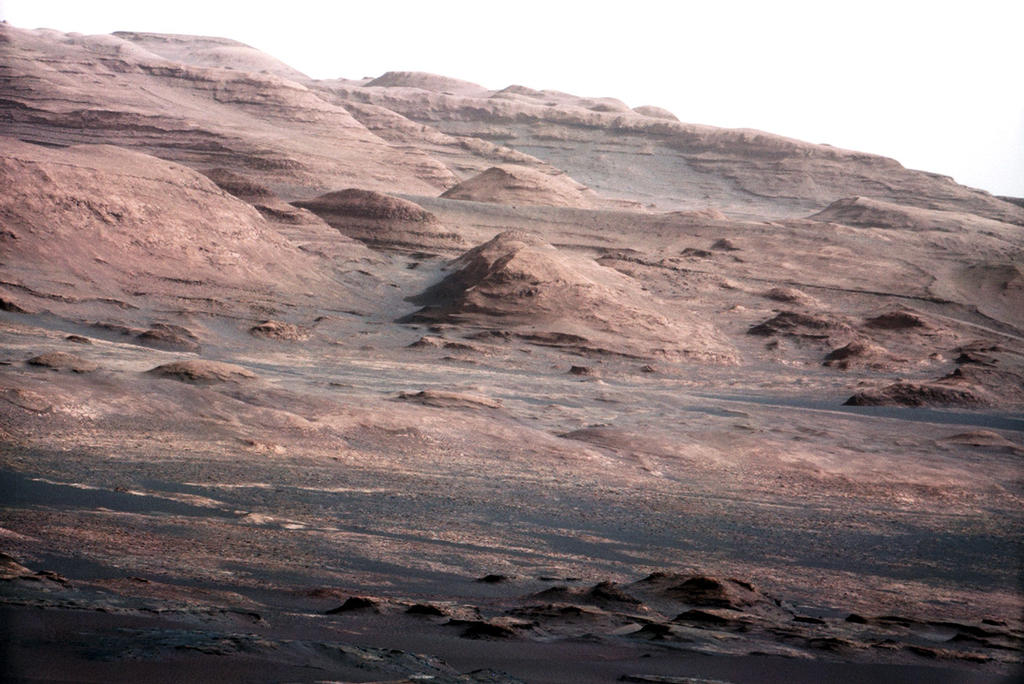
This image was taken by Front Hazcam onboard NASA’s Mars rover Curiosity on Sol 102 (2012-11-18 21:41:54 UTC). Credit: NASA/JPL-Caltech

The Mars Science Laboratory team has hinted that they might have some big news to share soon. But like good scientists, they are waiting until they verify their results before saying anything definitive. In an interview on NPR today, MSL Principal Investigator John Grotzinger said a recent soil sample test in the SAM instrument (Sample Analysis at Mars) shows something ‘earthshaking.’

“This data is gonna be one for the history books,” he said. “It’s looking really good.”

What could it be?

SAM is designed to investigate the chemical and isotopic composition of the Martian atmosphere and soil. In particular, SAM is looking for organic molecules, which is important in the search for life on Mars. Life as we know it cannot exist without organic molecules; however, they can exist without life. SAM will be able to detect lower concentrations of a wider variety of organic molecules than any other instrument yet sent to Mars.

As many scientists have said, both the presence and the absence of organic molecules would be important science results, as both would provide important information about the environmental conditions of Gale Crater on Mars.

But something ‘Earthshaking’ or “really good” probably wouldn’t be a nil result.

Already, the team has found evidence for huge amounts of flowing water in Gale Crater.

A detailed look at the layers on Aeolis Mons/Mt. Sharp, the central mound inside Gale Crater, the Curiosity rover’s ultimate destination. Credit: NASA/Caltech-JPL/MSSS

If SAM does find organic material, the next step would be to determine the origin and the nature of preservation of the molecules. But the team is going to wait until they verify whatever it is they found.

As NPR’s Joe Palca says in his report, “They have some exciting new results from one of the rover’s instruments. On the one hand, they’d like to tell everybody what they found, but on the other, they have to wait because they want to make sure their results are not just some fluke or error in their instrument.”

The team is being cautious because of their experience with looking for methane in the Martian air. When one of the SAM instruments analyzed an air sample, they got a reading of methane. But, it turned out, they were likely measuring some of the air that was brought along from Florida, as air leaked into the Tunable Laser Spectrometer (TLS) while the spacecraft was awaiting launch. The initial readings from the TLS, full of methane, were very exciting to the Curiosity scientists until they realized it was from Earth.

But NPR reports that Grotzinger says it will take several weeks before he and his team are ready to talk about their latest finding.

In the meantime there will likely be much speculation as everyone is excited about the prospects of life – past or present – on Mars. Either would have astounding implications.

Read more: http://www.universetoday.com/98576/has-curiosity-made-an-earth-shaking-discovery/#ixzz2CpTjbFD5

Yes!!! to the power on nature, and man’s ingenuity!!!

I love the concept of just using natural resources, wherever possible.

And of course, I have a love of yachting, so this really appeals to me. What an incredible speed has been achieved here! And without using any global warming energy!!!
———————————————————————–

Australian sets sailing speed record

Date     November 21, 2012 – 1:59AM
Andrew Drummond

AAP

Australian Paul Larsen has claimed a new sailing speed record, skimming a custom-built craft through African waters.

In calm Namibian conditions, Victorian-born Larsen, 42, on Sunday achieved an average 59.39 knots over 500 metres, overtaking the previous 55.65-knot record set in 2010 by a kite surfer.

A World Sailing Speed Record Council representative was on hand at Walvis Bay, where Larsen repeatedly broke the world record over a number of days, culminating in Sunday’s fastest attempt.

“On the day it was so calm we were wondering if it was even worth going out, but in this craft speed is determined by power versus drag and on this occasion it just all came together,” an overjoyed Larsen told AAP by phone from Namibia.

Sailing the second incarnation of his 40-foot-long and 40-foot-wide carbon fibre Vestas Sailrocket, Larsen said the record comes after a decade of attempts, inspired by a childhood fascination.

“From playing around with floating ice cream container lids in rural Victoria, I just developed this fascination with aerodynamics and hydrodynamics: experimenting with wind and water power,” said Larsen, who grew up at Healesville in the Yarra Valley.

The engineering degree dropout has worked with a professional team to build and modify the unique Sailrocket, which was manufactured on the Isle of Wight.

“By putting the sail right over one side and angling it, there’s no overturning levers … it doesn’t matter how much wind blows onto the boat, it won’t tip over … so those forces instead generate a huge amount of drive and power,” he said.

“I’m achieving 2.5-times the wind speed with this boat.”

Footage of a helmeted Larsen reaching speeds in excess of 63 knots in the bright orange craft end in jubilation as he and his team realise they have finally smashed the record.

But the challenge won’t end for the Australian, who is now based at Weymouth on England’s southwest coast.

“I’ve always loved sailing (and) always been fascinated by what you could possibly do with a boat. This can mean so much for the future of design and racing.”

© 2012 AAP